Recyclable, Compostable, and Biodegradable Packaging: Understanding the Difference
September 16, 2026

23 Apr 2026
You spent months — maybe years — getting your food product exactly right. The recipe, the flavor profile, the nutritional specs. But when it came time to package it, someone said, “Let’s just find something that works and deal with it later.”
That decision costs food brands more than they realize.
Packaging is consistently among the last conversations in product development, yet it is among the most consequential. When packaging is treated as an afterthought, the results show up in delayed launches, poor shelf performance, and production line headaches that nobody planned for.
The good news? The right packaging doesn’t have to cost more than the easy option. It just requires asking the right questions early.
When food brands come to a packaging supplier, they usually arrive with clear expectations: exact sizing, material preferences, and a set price point. That list represents the tip of the iceberg.
What’s below the waterline, shelf-life requirements, plant automation constraints, case-pack configuration, line denesting speeds, sustainability goals, EPR compliance, retail planogram requirements, is where the real packaging solution lives.
Most suppliers take the order. The right supplier asks questions.
At Display Pack, our custom packaging assessment digs into factors that a stock catalog simply can’t account for:
These aren’t afterthought questions. They’re the questions that determine whether your packaging helps your product succeed or quietly holds it back.
Stock packaging is appealing for one obvious reason: it’s available now, with no tooling investment. But the unit cost on an invoice is rarely the full picture.
Here’s what often gets missed when brands default to stock:
Oversized packaging wastes more than material. A container that doesn’t fit your product tightly uses more plastic per unit, takes up more case space, adds unnecessary shipping weight, and can cause product movement that affects presentation and shelf life. Right-sized custom packaging eliminates all of that.
Stock dimensions are built around averages — not your line. If your filling equipment, denesting system, or sealing machine isn’t optimized for the package you’re running, you’ll pay for it in downtime, changeover time, and inconsistent output.
Case packs built for your customer change the economics. A case pack configuration tailored to your retail or foodservice buyer reduces handling, improves receiving efficiency, and can directly impact your cost-to-serve. Generic case pack sizes are nobody’s first choice.
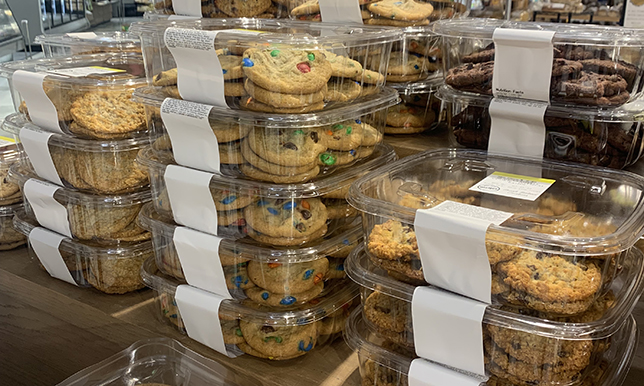
Shelf presentation is part of the product. A package that showcases your product — through good geometry, material clarity, and design — converts browsers into buyers. A generic container that barely fits your product does the opposite.
This is the assumption that holds food brands back from the conversation: custom packaging must cost more.
At higher volumes, custom thermoformed packaging frequently delivers a lower unit cost than stock alternatives, especially when you factor in material efficiency, reduced scrap, and optimized cycle times. The tooling investment is real, but it’s a one-time cost that Display Pack works to minimize by building all tooling in-house.
More importantly, the downstream savings from better packaging — faster line speeds, fewer quality holds, better case fill rates, improved shelf sell-through often dwarf the difference in unit cost.
The question isn’t “can we afford custom packaging?” The question is: “what is the easy option actually costing us?”
A packaging change made in the final weeks before a product launch can be ten times more expensive than one made during the design phase. Molds take time. Material qualifications take time. Line trials take time.
Food brands that bring their packaging supplier in early, not after the product is finalized, move faster, spend less on late-stage redesigns, and launch with packaging that was built for their product rather than adapted to it.
At Display Pack, we’ve been designing and manufacturing custom thermoformed food packaging for over 55 years. Our process starts with understanding what’s below the waterline — the operational, commercial, and regulatory requirements that a stock catalog can’t address.
We design it, tool it, and manufacture it, all under one roof in Cedar Springs, Michigan—giving us the control to deliver custom solutions with lead times and cost structures that rival stock options.
Let us walk you through our design process for a tailored solution, or choose from a wide variety of in-stock products.
Contact