Recyclable, Compostable, and Biodegradable Packaging: Understanding the Difference
September 16, 2026

16 Sep 2026
As consumers and brands place greater emphasis on sustainability, packaging terminology has become increasingly important. Words like recyclable, compostable, and biodegradable are appearing everywhere from packaging labels and marketing materials to product specifications and sustainability goals.
For food manufacturers, retailers, and product developers, understanding the difference is important when selecting packaging materials and communicating environmental claims. The right choice depends not only on the material itself, but also on how the package is designed, manufactured, used, and ultimately disposed of.
So, what is the difference between recyclable, compostable, and biodegradable packaging and how should brands determine which option is right for their products?
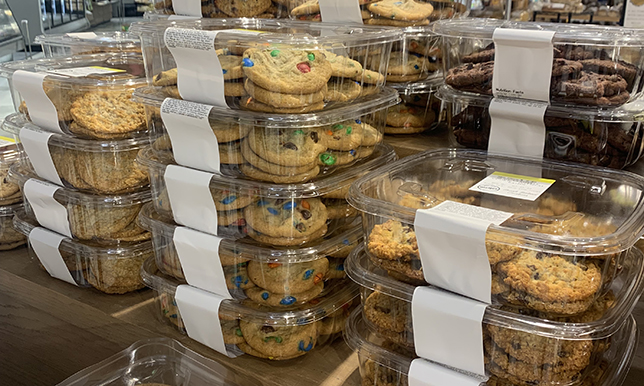
Recyclable packaging is designed so that its material can be collected, processed, and used to make new products or packaging. For example, PET is a widely recycled plastic and can be used to manufacture new packaging. Display Pack uses PET and recycled PET (rPET) in a range of food packaging applications. However, saying that a package is technically recyclable does not necessarily mean it can be recycled everywhere.
Recycling depends on several factors, including:
The Federal Trade Commission (FTC) advises marketers to qualify recyclable claims when appropriate recycling facilities aren’t available to a substantial portion of consumers.
Recyclability should be considered early in the packaging development process, not after the package has already been designed. Material selection, package geometry, components, labels, and other design decisions can all influence what happens to a package at the end of its useful life. At Display Pack, recyclability is considered throughout the product lifecycle, from resin selection and package design through manufacturing, shipping, and end-of-life considerations.
Compostable packaging is designed to break down into usable compost under appropriate composting conditions. That distinction is important. Composting is a managed biological process in which microorganisms break down organic materials under controlled conditions. A package described as compostable therefore needs to meet specific requirements for decomposition. It isn’t enough for a material to simply break down eventually.
According to the FTC, a compostable claim should be supported by competent and reliable scientific evidence showing that the materials in the product or package will break down safely into usable compost within an appropriate timeframe. Claims must also be qualified when a product requires commercial or industrial composting rather than home composting.
One of the most common sources of confusion is the difference between commercial/industrial composting and home composting. A package may be designed to compost under the temperature, moisture, oxygen, and processing conditions found at a commercial composting facility without being suitable for a backyard compost pile.
That means a brand considering compostable packaging should ask:
A compostable package is only part of the solution. The infrastructure required to properly process it also matters.
Biodegradable generally means that a material can be broken down by biological processes into naturally occurring substances.
However, “biodegradable” does not automatically tell you how quickly something will break down, under what conditions, or what happens to it after disposal. A material may biodegrade under certain environmental conditions but behave very differently in a landfill, where conditions may not support rapid decomposition.
Biodegradable and compostable may appear to be the same, but there are important differences. All compostable products are biodegradable but not all biodegradable products are compostable.
The U.S. Environmental Protection Agency makes this distinction: compostable plastics are intended to biodegrade under specific conditions into material that contributes to finished compost, while biodegradable plastics may be designed to biodegrade under other environmental conditions.
Not necessarily. This is an important consideration for brands evaluating packaging alternatives.
A package’s environmental impact isn’t determined by a single characteristic. Material sourcing, manufacturing, transportation, product protection, food waste, package weight, and end-of-life management all play a role.
For food packaging in particular, protecting the product is an important part of sustainability. Food waste is a significant contributor to landfill waste and greenhouse gas emissions and food packaging plays an important role in preserving food quality.
That means replacing a package with a material marketed as “more sustainable” isn’t necessarily an improvement if the new package provides inadequate product protection, requires substantially more material, or doesn’t have a practical end-of-life pathway.
For many food and retail applications, recyclable plastic packaging can provide product protection, clarity, lightweighting, and material recovery.
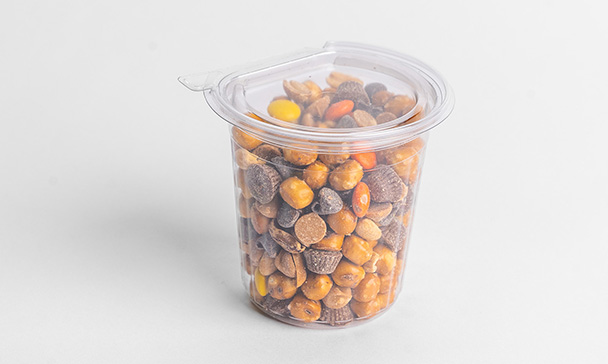
PET, for example, is strong, lightweight and recyclable. Display Pack uses recyclable PET across several food packaging products and incorporates recycled material into its manufacturing processes.
Sustainable packaging isn’t limited to switching from plastic to another material. It can also involve:
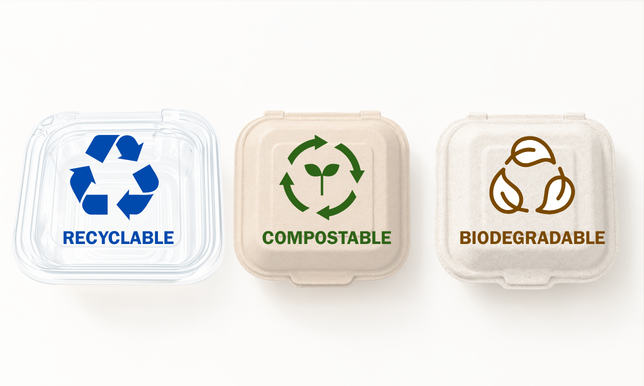
Recyclable, compostable, and biodegradable packaging each have a role to play, but they aren’t interchangeable terms. Before making a packaging decision, it’s important to consider whether the package will adequately protect the product and whether it can accomplish its purpose with less material. Brands should also evaluate whether the material can enter an appropriate recycling stream and, if compostable, where and under what conditions it can be processed. Incorporating recovered material into the package can further improve its sustainability profile, but only if the necessary recovery infrastructure actually exists. By looking at the full lifecycle, brands can make more informed packaging decisions and avoid relying on environmental buzzwords alone.
Choosing the right packaging material is only part of the process. At Display Pack, our team works with customers to develop custom thermoformed packaging designs that balances product protection, functionality, material efficiency, and recyclability.
Let us walk you through our design process for a tailored solution, or choose from a wide variety of in-stock products.
Contact